Excavator Market DACH 2026: What Buyers Need to Know Now
The excavator market in the DACH region faces three massive influences in 2026: stricter emission standards, digital networking as a purchasing criterion, and consolidation among manufacturers and dealers. Anyone purchasing an excavator in 2026 is investing not just in steel and hydraulics, but in a networked work system with telematics, Stage V engine technology, and partially fully electric drives. The global market size for hydraulic excavators is estimated at $54.86 billion in 2026, with projected growth of 4.6 percent CAGR through 2035. In the DACH region, established brands like Caterpillar, Liebherr, and Volvo continue to dominate, but manufacturers such as Hyundai, Hidromek, and Sany are gaining market share through aggressive pricing and service strategies. Delivery times have normalized in 2026 compared to 2023: standard track excavators in the 20-ton class are available again in 12-16 weeks, with special equipment extending to 20-24 weeks. Mini excavators up to 3 tons are partially available from stock. This article provides equipment managers and construction companies with a sound decision-making basis for purchasing in 2026.
Excavator Classes at a Glance: Applications and Typical Performance Data
Excavators are classified primarily by operating weight, design, and mobility. Each class has specific strengths that directly impact applications, transport logistics, and cost-effectiveness. Choosing the right class determines productivity, fuel costs, and resale value after five to eight years of operation.
| Class | Weight | Engine Power | Digging Depth | Typical Applications | Price Range New (€) |
|---|---|---|---|---|---|
| Mini Excavator | 0.8 – 6 t | 10 – 35 kW | 1.8 – 3.5 m | Landscaping, utility work, inner-city construction sites | 18,000 – 65,000 |
| Compact Excavator | 6 – 10 t | 35 – 55 kW | 3.5 – 4.8 m | Earthworks, pipeline work, foundations | 65,000 – 115,000 |
| Short-Tail Excavator | 8 – 18 t | 50 – 100 kW | 4.2 – 5.8 m | Urban earthworks, tight construction sites | 95,000 – 185,000 |
| Zero-Tail Excavator | 5 – 8 t | 30 – 50 kW | 3.0 – 4.2 m | Inner-city renovation, cemetery work | 55,000 – 95,000 |
| Mobile Excavator | 14 – 22 t | 90 – 130 kW | 5.0 – 6.5 m | Road construction, factory grounds, frequent relocation | 145,000 – 285,000 |
| Mid-Size Track Excavator | 18 – 30 t | 100 – 160 kW | 5.5 – 7.2 m | Earthworks, demolition, quarrying | 175,000 – 320,000 |
| Long-Arm Excavator | 20 – 35 t | 110 – 180 kW | 10 – 18 m | Waterway development, slope stabilization, demolition | 220,000 – 420,000 |
Mini excavators up to 6 tons numerically dominate the DACH market: approximately 12,400 units were registered in Germany in 2025, with 68 percent in the 1.5 to 3.5-ton class. Wacker Neuson, Caterpillar, and Takeuchi lead here with market shares between 14 and 19 percent. Compact excavators 6-10 tons are the workhorse of earthworks: high performance with manageable transport weight. Short-tail excavators enable work at sidewalk width without rear overhang – crucial for inner-city renovations. Mobile excavators combine track excavator performance with road mobility, but require compromises in stability and acquisition price. Mid-size track excavators represent the economic middle ground: versatile, robust, high resale values after eight years of operation.
Zero-Tail vs. Short-Tail: When Is the Premium Worth It?
Zero-tail excavators offer absolute tail dimension corresponding to track width, thus enabling work directly against building walls or between parked vehicles. The premium compared to conventional excavators of the same weight class is 8-12 percent. Short-tail excavators offer a compromise: reduced rear overhang (typically 850-1100 mm versus 1400-1650 mm with standard tail), but conventional engine arrangement and thus often better serviceability. For landscaping contractors with frequent courtyard applications, the zero-tail premium amortizes in 2.5-3.5 years through higher utilization. For classical earthwork contractors, short-tail design usually suffices.
Top Manufacturers in the DACH Market 2026: Market Shares and Strategic Positioning
The DACH excavator market is characterized by high brand loyalty and established dealer networks. Caterpillar, Liebherr, and Volvo together hold approximately 42 percent market share for new machines over 10 tons. Mini excavators are dominated by specialized providers. Asian manufacturers are catching up but remain below 18 percent total share in the DACH region – significantly less than in Southern Europe (28 percent) or Eastern Europe (35 percent).
Caterpillar: Market Leader with Premium Positioning
Caterpillar holds approximately 16.5 percent market share in the DACH region for excavators over 6 tons in 2026. Strengths: worldwide dealer network, high resale values (20-tonner after 5 years approximately 52-58 percent of new price), comprehensive telematics integration via Cat Product Link. Next-generation excavators (320 GC, 323, 330) meet Stage V with selective catalytic reduction without diesel particulate filter regeneration during normal operation. Average fuel consumption 320 GC: 12.8 liters/hour during earthwork, 8.4 liters/hour in Eco mode. Weaknesses: acquisition price 8-12 percent above Volvo and Komatsu for comparable models, spare parts availability for wear parts sometimes 3-5 days delivery time.
Liebherr: Technology Leader from the DACH Region
Liebherr achieves 14.2 percent market share in its home DACH market, with focus on the 14-45-ton class. The Kirchdorf facility (Austria) produces approximately 3,200 track excavators annually. Unique selling points: Liebherr Assistance Systems with boom and bucket assist for semi-automated leveling, standard load-sensing hydraulics from the 20-ton class onward, in-house engine manufacturing. The R 920 Compact (operating weight 20.8 t, 110 kW) is considered the benchmark for fuel efficiency: 13.1 liters/hour in standard cycle, 9.6 liters/hour in Eco mode.
Volvo Construction Equipment: Balance of Price and Performance
Volvo holds 11.8 percent DACH market share with focus on the 12-30-ton class. The EC series scores with integrated weighing systems (Volvo Co-Pilot), automatic engine shutdown after adjustable idle time, and above-average low maintenance costs. The EC220E (22 t, 129 kW) consumes an average of 14.2 liters/hour in practical operation, placing it 6 percent below comparable Caterpillar and Komatsu models.
JCB: Innovator in Drives and Mobile Concepts
JCB achieves 6.4 percent DACH market share, with focus on mobile excavators (Hydradig series) and compact class. The Hydradig 110W revolutionizes the mobile excavator concept through mid-articulation steering. JCB is investing heavily in hydrogen drive: the prototype 220X H2 completed over 850 operating hours in 2025, series production announced for 2027.
Komatsu, Hyundai, Wacker Neuson, Mecalac, Sennebogen
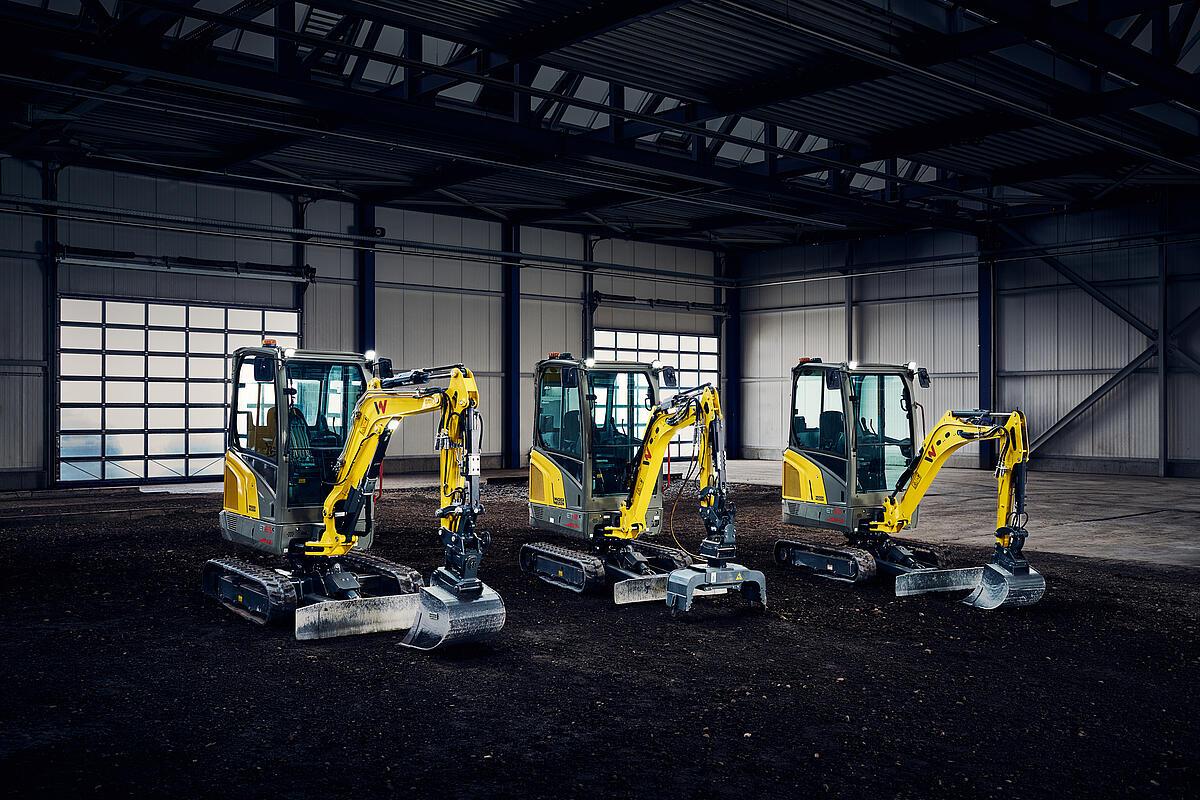
Komatsu (8.9 percent DACH market share) scores with Komtrax telematics and preventive maintenance through AI analysis. Hyundai (4.7 percent, rising) undercuts premium brands by 14-18 percent with comparable equipment. Wacker Neuson dominates zero-tail and mini excavators 1-6 tons with 21.3 percent in this segment. Mecalac (3.1 percent) offers with the e12 the only fully electric 12-ton excavator with road approval. Sennebogen specializes in material and scrap handling.
Drive Trends 2026: Diesel Stage V, Hybrid, Electric, Hydrogen
The drive landscape for excavators in 2026 is more diverse than ever. Diesel Stage V remains standard, but alternative drives are gaining market share.
Diesel Stage V: Technology Maturity Achieved
All excavators sold in the DACH region have met EU Stage V since 2021. SCR systems for engines over 56 kW, DOC+DPF for smaller engines. DPF system failure rates are 0.4 percent over 2,000 operating hours. AdBlue consumption is 3-5 percent of diesel consumption. Stage V additional costs compared to older standards have decreased from initial 8-12 percent (2021) to 3-5 percent (2026).
Hybrid Drives: Fuel Savings 15-25 Percent
Hybrid excavators combine diesel engines with electric generators and battery storage. Energy from swing brake operations and boom lowering is recovered. Komatsu HB215LC-3 (21.5 t hybrid) saves 18-23 percent fuel compared to conventional PC210LC for cyclic loading tasks. Hybrid premium: 32,000-48,000 euros compared to diesel equivalent.
Fully Electric Excavators: Market Ready up to 10 Tons
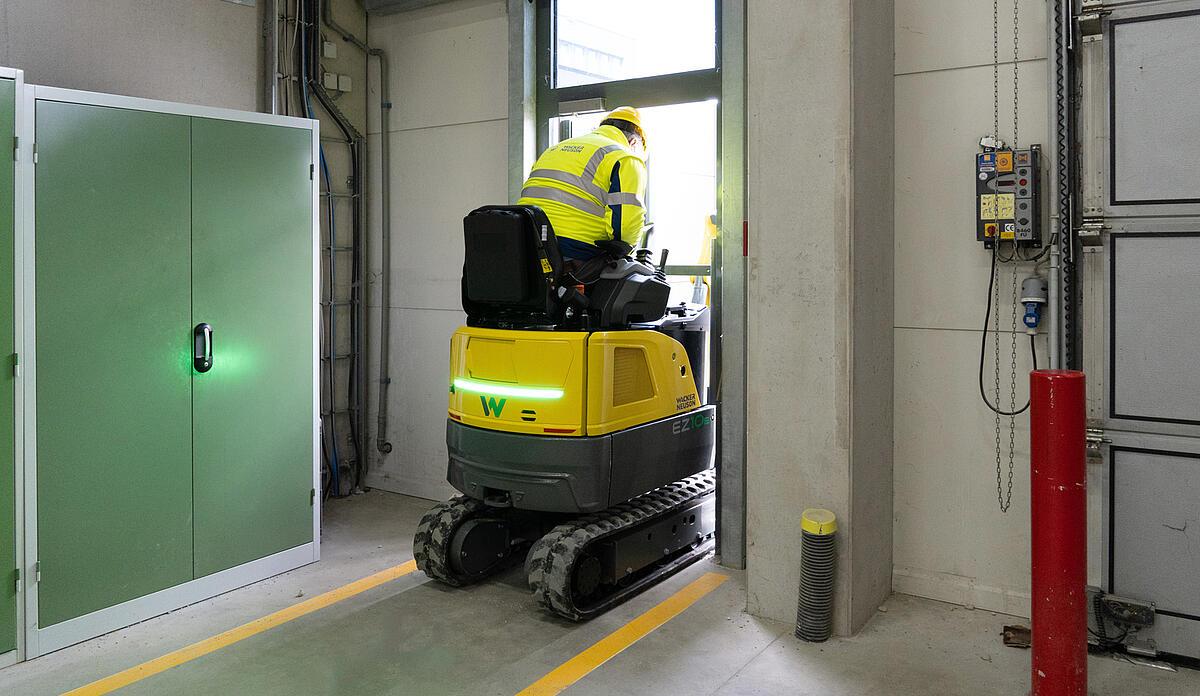
Electric excavators are series-ready in 2026 up to 10 tons operating weight. Wacker Neuson offers EZ17e, ET16, ET24, and ET90 with operating times 6-10 hours. Mecalac e12 (12 t) is the largest series electric excavator with road approval. Electricity costs at commercial rates 0.28 euros/kWh: approximately 12.60 euros for full charge 45-kWh battery (equivalent to approximately 32 liters diesel = 46.40 euros). Energy savings: 73 percent. Maintenance costs drop 40-55 percent.
Hydrogen Drive: Technology Demonstration
JCB accumulated over 850 operating hours with H2 prototype 220X in 2025. At H2 price 12 euros/kg, fuel costs amount to 50.40 euros/hour – threefold over diesel. Realistic series deployment of H2 excavators at earliest 2028-2030 for major infrastructure projects with on-site H2 generation.
Telematics and Digitalization: From Add-On Feature to Purchasing Criterion
Telematics is standard in 2026 for all new excavators from 6 tons. All major manufacturers offer proprietary telematics platforms: Caterpillar Product Link, Komatsu Komtrax, Volvo CareTrack, Liebherr LiDAT, JCB LiveLink. Buyers should clarify data ownership contractually: opt-out for manufacturer access, no sharing with third parties, right to data export in open formats.
3D Machine Control: Productivity Plus 15-30 Percent
3D control systems such as Trimble Earthworks, Leica iCON excavate, and Topcon X-53x enable centimeter-accurate work without survey stakes. Construction companies report 15-30 percent time savings for grading work, 40 percent fewer rework items, and 10-12 percent fuel savings. Investment amortizes at 800-1,200 operating hours per year within 18-24 months.
Subsidies and Tax Incentives DACH Region 2026
Germany offers subsidies via the BMDV program "Climate-Friendly Construction Machinery" of 40 percent of additional investment costs for electric and hydrogen excavators compared to diesel equivalent, maximum 180,000 euros per machine. Austria grants via UFI subsidies up to 35 percent, maximum 100,000 euros per unit. Switzerland supports via cantonal programs: Zurich 25 percent subsidy when replacing units manufactured before 2010, Geneva flat premium 40,000 CHF for fully electric excavators from 20 tons.
Checklist for Excavator Selection 2026
Clarify application profile: Average daily operating hours (under/over 6 hours determines electric suitability), transport distances, ground types. Realistically estimate annual operating hours.
Calculate TCO over lifecycle: Compare acquisition price, financing costs, fuel/electricity, maintenance contracts, resale value after 5/7 years, insurance premiums for batteries.
Dealer network and service: Service center within 50 km radius, 24-hour emergency service, replacement equipment provision during downtime, training offerings.
Check future-readiness: Software update capability (OTA), compatibility with fleet management systems, availability of emission class upgrades, preparation for autonomous functions.
Market Outlook 2027-2030
Analysts expect for the DACH region until 2030 a decline in diesel new machine market of 35-40 percent, while electric share rises to 28-32 percent. Hydrogen remains a niche under 5 percent market share due to infrastructure deficits. Manufacturer consolidation likely – maximum 6-7 global providers will survive.
Frequently Asked Questions
Is it still worthwhile in 2026 to purchase a diesel excavator or should one wait for electric?
For intensive use over 1,000 hours annually and applications over 6-8 hours daily, modern Stage V diesel excavators make economic sense and are usable at least until 2035. Electric excavators are already perfectly suited for urban applications with short work cycles.
What operating cost differences exist between 20-ton diesel and electric?
Diesel 20-tonner: 17.40-21.75 euros fuel costs/hour. Electric equivalent: 9.80-12.60 euros/hour – savings 45 percent. Maintenance costs electric 30 percent lower. Over 1,500 operating hours annually, total savings with electric amount to 12,000-15,000 euros.
How long do batteries last in electric excavators?
Manufacturers guarantee 3,000-5,000 charge cycles or 8-10 years with at least 70 percent residual capacity. Battery replacement costs 35,000-65,000 euros depending on capacity. Battery lease models (800-1,400 euros/month) offer guaranteed replacement.
Are used excavators from abroad in the EU a cost-effective alternative?
Western European imports 10-18 percent cheaper, Eastern European 25-35 percent cheaper. Risks: unclear history, manipulated hour counters. Definitely arrange expert evaluation (400-800 euros) and guarantee minimum 12 months.
What attachment compatibility must be considered when purchasing an excavator?
Hydraulic quick couplers are manufacturer-specific (OilQuick, Verachtert, Lehnhoff). Hydraulic power determines attachment suitability. Standardized ISO interface mandatory only from 2027 onward. Plan adapter budget 1,200-3,500 euros per device.
How does the machinery tax in Switzerland affect the purchase?
Zurich approximately 850 CHF/year for 20-ton excavator, Bern 720 CHF, Geneva flat 600 CHF. Electric excavators fully tax-exempt in 18 of 26 cantons until 2030.
What insurance is mandatory?
Construction equipment liability is mandatory (0.8-1.4 percent of new value annually). Machinery breakdown/comprehensive insurance optional but recommended (2.5-4.5 percent). GPS tracking reduces theft premiums by 8-15 percent.
Status and Updates
Status: May 2026. This overview is updated quarterly – market shares, Stage V compliance status, and subsidy programs may change.