Road Construction Market DACH 2026: Investments and Machine Fleet in Transition
The DACH road construction market in 2026 is characterized by massive renewal programs. Germany alone invests approximately 12.4 billion euros annually in its federal highway network, of which 6.8 billion goes to renovation and maintenance. Austria is increasing its road budget to 3.2 billion euros, and Switzerland is planning investments of 14.5 billion francs for 2026-2030. This is driving demand for high-performance asphalt pavers, tandem rollers, and cold milling machines.
Technological development focuses on three pillars: Stage-V drives with SCR systems, telemetry-based installation quality control, and hybrid compaction for low-emission inner-city construction sites. Manufacturers such as Wirtgen, Vögele, Hamm, Bomag, Dynapac, and Caterpillar will present machine concepts in 2026 that measurably improve installation quality, fleet efficiency, and CO₂ balance.
The used machine market shows significant price increases: asphalt pavers in the 5-10-year class are recording value increases of an average of 18 percent compared to 2024. The reason is long delivery times for new machines – currently 8 to 14 months for Vögele Super series and Wirtgen W milling machines over 2 meters working width.
Asphalt Pavers 2026: Wirtgen Vögele, Dynapac, Bomag in Technology Comparison
Asphalt pavers form the heart of every paving site. Performance classes range from compact 3-meter wheeled pavers for sidewalks to 12-meter road pavers for highway renovations. The DACH market is clearly dominated by three manufacturers: Wirtgen Vögele holds 47 percent market share, Dynapac 26 percent, Bomag 18 percent. The remaining 9 percent is divided among Caterpillar, Volvo, and specialized providers.
The Wirtgen Vögele Super series sets the standard in 2026 for the mid and upper classes. The Super 1800-3i achieves paving performance of up to 1,200 tons per hour for wearing courses with its 3-10 meter AB 340 screed. The Niveltronic Plus system monitors screed position via nine sensors with an accuracy of ±2 mm over a 10-meter reference length. The material hopper holds 15 tons, and the Cummins Stage-V engine delivers 165 kW. Starting price ex-works: 487,000 euros net for the basic configuration; with high-compaction screed and automatic grade matching, the price rises to 542,000 euros.
Dynapac positions its SD series as a cost-effective alternative with robust mechanics. The SD2500CS combines classic tracked drives with modern sensors. Working width 2.5 to 9 meters, maximum paving performance 800 tons/hour. The Deutz Stage-V engine delivers 129 kW, and the electro-hydraulic screed heating system reaches operating temperature in 18 minutes. Special feature: The patented free-flow auger screw reduces segregation through asymmetrical pitch. Price: 368,000 euros, which is 22 percent below comparable Vögele models.
Bomag focuses on hybrid drives with the BF series for emission-critical inner-city projects. The BF800P features a 95-kWh battery pack for up to 4 hours of pure electric operation. Maximum working width 8 meters, electric paving performance 450 tons/hour, 720 tons/hour in diesel parallel operation. The screed heats via induction modules instead of gas burners. Noise emission: 68 dB(A) electric, 84 dB(A) diesel. Price: 521,000 euros – the premium solution for noise protection zones.
| Model | Manufacturer | Engine kW | Max. WW m | Performance t/h | Hopper t | Weight t | Price € net |
|---|---|---|---|---|---|---|---|
| Super 1800-3i | Vögele | 165 | 10.0 | 1,200 | 15.0 | 22.8 | 487,000 |
| SD2500CS | Dynapac | 129 | 9.0 | 800 | 13.5 | 19.4 | 368,000 |
| BF800P Hybrid | Bomag | 118 + 95 kWh | 8.0 | 720 | 12.0 | 24.1 | 521,000 |
| F182CS | Dynapac | 115 | 8.2 | 680 | 11.5 | 17.9 | 342,000 |
| Super 1203-3i | Vögele | 105 | 6.5 | 600 | 9.0 | 14.2 | 298,000 |
Installation quality differs measurably: Vögele machines achieve average flatness values of 1.2 mm/m (3-meter straightedge) in DACH reference projects, Dynapac 1.6 mm/m, Bomag Hybrid 1.4 mm/m. However, the overall system consisting of paver, screed, roller sequence, and asphalt temperature is decisive.
Tandem and Rubber Rollers 2026: Hamm, Bomag, Caterpillar in Compaction Comparison
Asphalt compaction determines the service life of every pavement. Tandem rollers dominate with 73 percent market share, rubber rollers covering special requirements for SMA and PmB pavements. Hamm leads the DACH segment with 38 percent market share ahead of Bomag (31 percent) and Caterpillar (14 percent). Dynapac, Volvo, and Ammann share the remaining 17 percent.
Hamm sets new standards in 2026 with the HD+ series for intelligent compaction. The HD 14i VV combines 14 tons operating weight with full hydraulic drive and HCQ Navigator system. The system measures compaction degree continuously via acceleration sensors in both drums, displays over- and under-compaction color-coded, and automatically controls amplitude and frequency. Working width 2,130 mm, centrifugal force 2×186 kN, continuously variable frequency 30-60 Hz. The Deutz Stage-V engine delivers 129 kW. Price: 247,000 euros with fully automatic compaction documentation.
Bomag counters with the BW series and patented Asphalt Manager. The BW 174 AP-5 weighs 17.4 tons and generates 2×214 kN centrifugal force at 67 Hz maximum frequency. The Bomag Bomap system automatically creates geo-referenced compaction protocols according to TL Asphalt-StB and ZTV Asphalt-StB. Special feature: The Variocontrol function adjusts amplitude in real-time to compaction resistance and prevents over-compaction. Working width 2,140 mm, slope up to 58 percent. Price: 239,000 euros.
Caterpillar offers cost-effective high-performance rollers with the CB series for municipal use. The CB13 weighs 13.2 tons and delivers 2×152 kN centrifugal force at 50 Hz. The Cat C4.4 engine meets Stage V with DOC+SCR without AdBlue refilling for up to 800 operating hours. Working width 2,130 mm, turning radius 7.8 meters. The machine forgoes compaction measurement but offers robust mechanical design. Price: 198,000 euros – ideal for municipalities with limited budgets.
Rubber rollers remain indispensable for intermediate and final compaction stages. The Hamm GRW 280i combines 28 tons ballast weight with 11 rubber tires 23.1-26. Tire internal pressure hydraulically adjustable 2.5-8.5 bar, working width 2,700 mm. The machine compacts SMA pavements with PmB binders without rutting. Price: 312,000 euros.
Compaction Performance in Practical Comparison
Field tests by TU Munich 2025 showed the following average values for 6 cm placement thickness AC 11 D S over 1,000 m² reference area: Hamm HD 14i VV achieved 98.2 percent compaction degree (Marshall) after 5 passes, Bomag BW 174 AP-5 98.4 percent after 6 passes, Caterpillar CB13 97.8 percent after 7 passes. The intelligent amplitude control of Hamm and Bomag reduced the number of necessary passes by an average of 1.3 compared to conventional control.
| Model | Weight t | Centrifugal Force kN | Frequency Hz | WW mm | Intelligence System | Price € net |
|---|---|---|---|---|---|---|
| Hamm HD 14i VV | 14.0 | 2×186 | 30-60 | 2,130 | HCQ Navigator | 247,000 |
| Bomag BW 174 AP-5 | 17.4 | 2×214 | 28-67 | 2,140 | Asphalt Manager | 239,000 |
| Caterpillar CB13 | 13.2 | 2×152 | 31-50 | 2,130 | — | 198,000 |
| Dynapac CC4200 VI | 14.5 | 2×192 | 30-55 | 2,130 | Compaction Analyzer | 232,000 |
| Hamm GRW 280i | 28.0 | 11 Tires | 2.5-8.5 bar | 2,700 | Ballast Control | 312,000 |
Cold Milling Machines 2026: Wirtgen W Series, Caterpillar, Bomag in Milling Performance Comparison
Cold milling machines dominate road renovation in the DACH region. 78 percent of all pavement renewals are performed using milling-placement methods. Wirtgen controls 62 percent market share in milling machines over 1 meter working width, Caterpillar 17 percent, Bomag 12 percent. The remaining 9 percent goes to Dynapac, Marini, and specialized providers such as Sany.
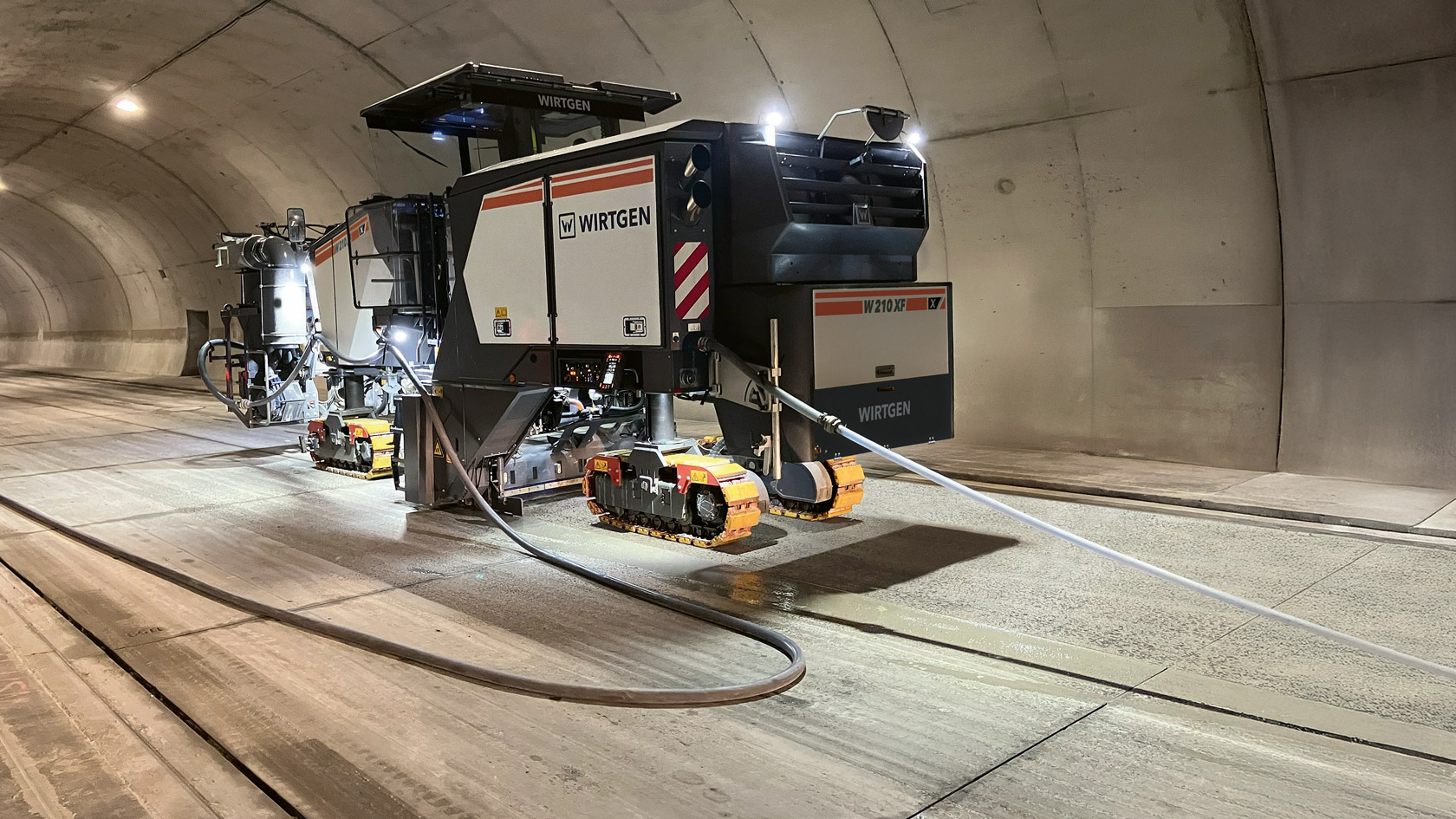
The Wirtgen W 200 Fi defines the 2-meter class in 2026. Working width 2,000 mm, maximum milling depth 330 mm, milling drum rotation speed 0-122 RPM. The Cat C9.3B engine delivers 400 kW (544 PS) with Stage-V compliance. The machine mills up to 100 meters per minute advance at 50 mm depth in AC 16 D S. The load-sensing hydraulic system automatically adjusts engine load to milling resistance and reduces fuel consumption by 17 percent compared to constant-speed-controlled systems. Operating weight: 25,950 kg. Price: 872,000 euros.
The larger Wirtgen W 210 Fi achieves 2,100 mm working width and 350 mm maximum depth. Engine power 460 kW, weight 30,400 kg. For full-depth milling (200+ mm) in bound layers, the W 210 Fi averages 42 meters per minute. The conveyor belt system with dual-belt configuration loads two trucks in parallel, reducing idle times by 28 percent. Price: 1,124,000 euros.
Caterpillar positions the PM series as a price-performance alternative. The PM 620 combines 2,000 mm working width with robust mechanical design. Cat C15 engine with 470 kW, milling depth 330 mm, advance up to 85 meters/minute. Special feature: The direct-drive milling drum drive eliminates hydraulic motors and reduces maintenance costs by an estimated 12,000 euros over 5,000 operating hours. Weight: 27,100 kg. Price: 748,000 euros – 14 percent below comparable Wirtgen W 200 Fi.
Bomag focuses on compact milling machines with the BM series for municipalities. The BM 1300/30 weighs only 13,800 kg at 1,300 mm working width and 300 mm milling depth. Deutz engine with 205 kW, advance 60 meters/minute. The machine fits on standard lowboy trailers up to 3.5 meters width and requires no special permit. Price: 398,000 euros – ideal for depots with mixed application profiles.
Milling Tooth Costs and Wear 2026
Milling teeth account for 22-31 percent of cold milling machine operating costs. Standard teeth (HM 13-18 mm) cost between 4.80 and 7.20 euros per piece in 2026. A Wirtgen W 200 Fi carries 246 teeth on the milling drum. With average wear in AC pavements, teeth last 180-240 m² milling area. Calculation: 10,000 m² milling area requires approximately 10,200 tooth replacements, corresponding to material costs of 53,000 euros for premium teeth.
| Model | Manufacturer | Engine kW | WW mm | Depth mm | Advance m/min | Weight t | Price € net |
|---|---|---|---|---|---|---|---|
| W 200 Fi | Wirtgen | 400 | 2,000 | 330 | 100 | 25.95 | 872,000 |
| W 210 Fi | Wirtgen | 460 | 2,100 | 350 | 95 | 30.40 | 1,124,000 |
| PM 620 | Caterpillar | 470 | 2,000 | 330 | 85 | 27.10 | 748,000 |
| BM 1300/30 | Bomag | 205 | 1,300 | 300 | 60 | 13.80 | 398,000 |
| CC 3300 C | Dynapac | 335 | 1,800 | 315 | 78 | 22.40 | 687,000 |
Recyclers and Stabilizers: Soil Construction Machines for Base Layer Renovation 2026
Soil stabilization and cold recycling are gaining massively in importance in 2026. The CO₂ balance of cold recycling is 68 percent lower than conventional removal-rebuild. Wirtgen dominates with its WR recyclers (47 percent market share), followed by Caterpillar RM series (22 percent) and Bomag MPH series (18 percent).
The Wirtgen WR 240i recycles asphalt layers up to 400 mm depth in one pass. Working width 2,400 mm, rotor diameter 1,220 mm with 432 teeth. The Cat C18 engine delivers 485 kW. The system injects bitumen emulsion, cement, or foamed bitumen directly into the milling area, mixes and compacts in a continuous process. Production capacity: 1,800 m² per hour at 250 mm depth. Weight: 34,200 kg. Price: 1,487,000 euros including binder injection system.
Caterpillar RM 500 combines milling, mixing, and placement in one machine. Working width 2,500 mm, depth 500 mm, engine 522 kW. The machine stabilizes base layers with 2-4 percent cement or recycles asphalt with foamed bitumen. Special feature: The integrated water tank holds 4,200 liters for cement activation. Production capacity: 2,100 m² per hour at 300 mm. Price: 1,312,000 euros.
Bomag MPH 364-2 weighs only 24,800 kg and is suitable for base layer stabilization in rural road construction. Working width 2,400 mm, depth 360 mm, engine 298 kW. The twin-shaft mixing system achieves 95 percent homogeneity according to DIN EN 14227-10. Production capacity: 980 m² per hour. Price: 847,000 euros.
Practical example Federal Road B27 Rottweil-Villingen 2025: On an 8.4 km section, a Wirtgen WR 240i recycled the bound base layer (180 mm AC-T) with 3 percent foamed bitumen. Total capacity: 142,000 m² in 18 working days. Binder consumption: 387 tons bitumen, cost 284,000 euros. Savings compared to removal-rebuild: 1.87 million euros material and disposal costs, 4,200 tons CO₂.
Hot Feed Systems and Material Logistics 2026: Underestimated Efficiency Factors
Hot feed systems (Material Transfer Vehicles, MTV) stabilize asphalt temperature between mix plant truck and paver, eliminate segregation, and measurably improve placement quality. The DACH market comprises approximately 420 MTV units in 2026, of which 68 percent from Wirtgen Vögele, 19 percent from Bomag, 13 percent from other manufacturers.
The Vögele MT 3000-2i holds 30 tons asphalt in an insulated hopper and maintains material above 140°C for 95 minutes. The remix conveyor system with counter-running scrapers mixes horizontally and vertically, eliminating temperature gradients below 4 Kelvin. The Deutz Stage-V engine delivers 160 kW. Empty weight: 18,200 kg. Price: 368,000 euros.
Bomag TA 230 weighs only 14,600 kg empty and holds 23 tons. The patented high-output conveyor belt achieves 1,100 tons per hour throughput. Special feature: The hydraulically adjustable discharge unit enables paver hopper filling even on narrow roads without maneuvering. Price: 287,000 euros.
Field measurements TU Darmstadt 2025 showed: Placement with MTV reduces longitudinal seam cold joints by 73 percent, temperature striping by 81 percent, and standard deviation of bulk density by 0.8 percentage points. Calculation for highway construction site A8 Augsburg-Munich 2025: 84,000 tons placement over 14 weeks. With MTV deployment: 7 corrections after acceptance, without MTV historical average: 34 corrections. Savings: estimated 127,000 euros.
Drives for Road Construction 2026: Stage V, Hybrid Rollers, and Synthetic Fuels
Stage V determines engine technology in road construction in 2026. All manufacturers rely on SCR systems (Selective Catalytic Reduction) with AdBlue injection. Particulate filters (DPF) and diesel oxidation catalysts (DOC) are standard. Typical AdBlue consumption: 4-6 percent of diesel consumption. A Wirtgen W 200 Fi consumes approximately 280 liters diesel and 14 liters AdBlue per day at 8 hours full load.
Hybrid drives remain limited to rollers and individual pavers in 2026. Bomag leads with approximately 180 delivered hybrid rollers BW 174 AP-H since 2023. The system combines 95-kW diesel engine with 48-kWh lithium-iron-phosphate battery. In electric mode, the roller achieves 3.2 hours operation at reduced compaction performance (65 percent rated power). Charging time 220-400V/63A: 2.8 hours. Premium over diesel model: 73,000 euros. Break-even at 4,200 operating hours (basis: diesel 1.45 €/l, electricity 0.28 €/kWh site power).
HVO fuels (Hydrotreated Vegetable Oil) such as Neste MY Renewable Diesel allow up to 90 percent CO₂ reduction in 2026 without engine modification. Caterpillar, Wirtgen, and Volvo approve 100 percent HVO operation on current Stage-V engines. Availability DACH region: 127 fuel stations (as of March 2026), premium over diesel: 0.18-0.26 €/liter. Large consumers negotiate framework contracts from 50,000 liters annually with surcharges around 0.12 €/liter.